
Joshua

“‘The Book of the Law shall not depart from your mouth, but you shall meditate on it day and night, so that you may be careful to do according to all that is written in it. For then you will make your way prosperous, and then you will have good success. Have I not commanded you? Be strong and courageous. Do not be frightened, and do not be dismayed, for the Lord your God is with you wherever you go.’”
Though Moses was gone and God was starting a new chapter in the Israelite’s life, this did not mean they could forget all that had happened before them. Joshua starts by commissioning the people to remember and follow God’s word. They had been waiting for their promised land so long and all the Law had been given in preparation for them to enter it.

Just as Moses had sent twelve spies into the promised land ahead of Israel, Joshua sent two spies. This time they found God’s favor on them and their people. All of Jericho was afraid, knowing of what God had done for Israel in the past. The men that had been sent in were helped by a prostitute. This woman then asked to be spared and the spies made an oath that they would not harm her household. Why would the author include the detail that the woman was a prostitute? What would that show the Israelites that would later read the book of Joshua? Why would this story of the spies and the woman who helped them be included? How does this contrast the story of the twelve spies in Numbers? This time the men came back with confidence to encourage Israel. How does this affect the rest of the book?
Just as God had led the Israelites out of slavery in Egypt through the Red Sea, He led Israel into the promised land through the Jordan River. This time, instead of through a pillar of cloud and fire, God led the people through the ark of the covenant. Now that Israel had their law and the way God’s presence could be near them was established with the ark, He led them in this way. Once the people got to the other side and camped for the night they set up a memorial, as God commanded, to remind them of what God had done for them. Through all generations, the Israelites would know who led them and who caused them to prosper in the land. Why would God ask them to use stones from the river? Why would God perform the same miracle as the people entered the promised land?
A chiasm is a literary device used where a set of ideas are written and then laid out in the text once again in reversed order. There are plenty throughout the Bible, most commonly in the narrative books, like Joshua and the Gospels, and the poetry of the Psalms and the Prophets. While studying last year, I realized a chiasm that wasn’t really a literary device used by an author in the Word, instead I saw that Joshua 5 ends a huge chiasm that spans from Exodus to Joshua. Here is how I would observe a chiasm:
A. Holy Ground (Exodus 3:5)
B. Circumcision of Nation (Exodus 4:24-26)
C. Crossing the Red Sea (Exodus 14)
D. Moses goes up Mount Sinai (Exodus 19:20)
E. The Law Given (Exodus-Deuteronomy)
D. Moses goes up Mount Nebo (Deuteronomy 34:1)
C. Crossing the Jordan River (Joshua 3)
B. Circumcision of Nation (Joshua 5:2-9)
A. Holy Ground (Joshua 5:15)
This chiasm spans five books and at least two authors. Instead of a writer using this literary device to emphasize an idea, this format was used to show the God’s favor was upon the Israelites and He was finishing what He started with Moses in Israel.
Why would this be the order of events? Would Israelites reading a compilation of these books recognize this pattern? Why would the Law be at the center?
The contrast of chapters 6 and 7 are clear. Chapter 7 starts with “But…” showing that what God did for the Israelites and how the people devoted the city to destruction as commanded was not the end of the story. God tells Joshua that the reason they fled from Ai instead of conquering them as they had with Jericho was because the people were now devoted to destruction. This meant that they were set apart as an offering of destruction because they had not done so with the plunder of Jericho as God had told them to. Why would they be replaced as the offering? Why would God require the man that kept some of the plunder to die? Why would the author include a story of Israel fleeing from another nation?

The contrast between Israel’s first time attacking Ai and its second is obvious. The missing factor was God’s favor. The people learned the real consequences of not following through fully on God’s command and once they did He forgave them and blessed them once more. This is the covenant in practice. The Lord made a way for the people always to come back to Him, for Him to always get to bestow blessings and prosperity upon them. Pull out the differences of the two attacks and ask why these battles would be recorded in the book of Joshua.
The land of Gibeon deceived the Israelites, and without taking council from the Lord, they fell into the trap. Though God asked Israel to devote all the nations promised to them to full destruction, the Gibeonites tricked them into making a covenant with them. The stories in Joshua often alternate between highs and lows for Israel, following their obedience and disobedience to the Lord.
Now that Israel was in a binding covenant with Gibeon, when the Kings of surrounding nations decided to ambush Gibeon, Israel went out to fight for them. God fought for the people on that day and the text says the sun stood still. Rocks were thrown from the heavens and the nations were thrown into chaos. God was showing His people that He was not sending them to fight alone and that their battles would be won because of Him. What would the significance of the sun standing still be to all Israelites that would read this text and pass it down through generations? Why after the ups and downs of these chapters would the story then go into all the nations Israel took at the end of chapter 10?

Day 67
Joshua 11-13
Throughout chapter 11, the phrase “Just as Moses, the servant of the Lord commanded.” is repeated. All that God had commanded the people in the wilderness, Joshua was making sure they did. This was a new season in the Israelite’s lives and a whole new generation but the Word of the Lord followed them as His promise was being fulfilled.
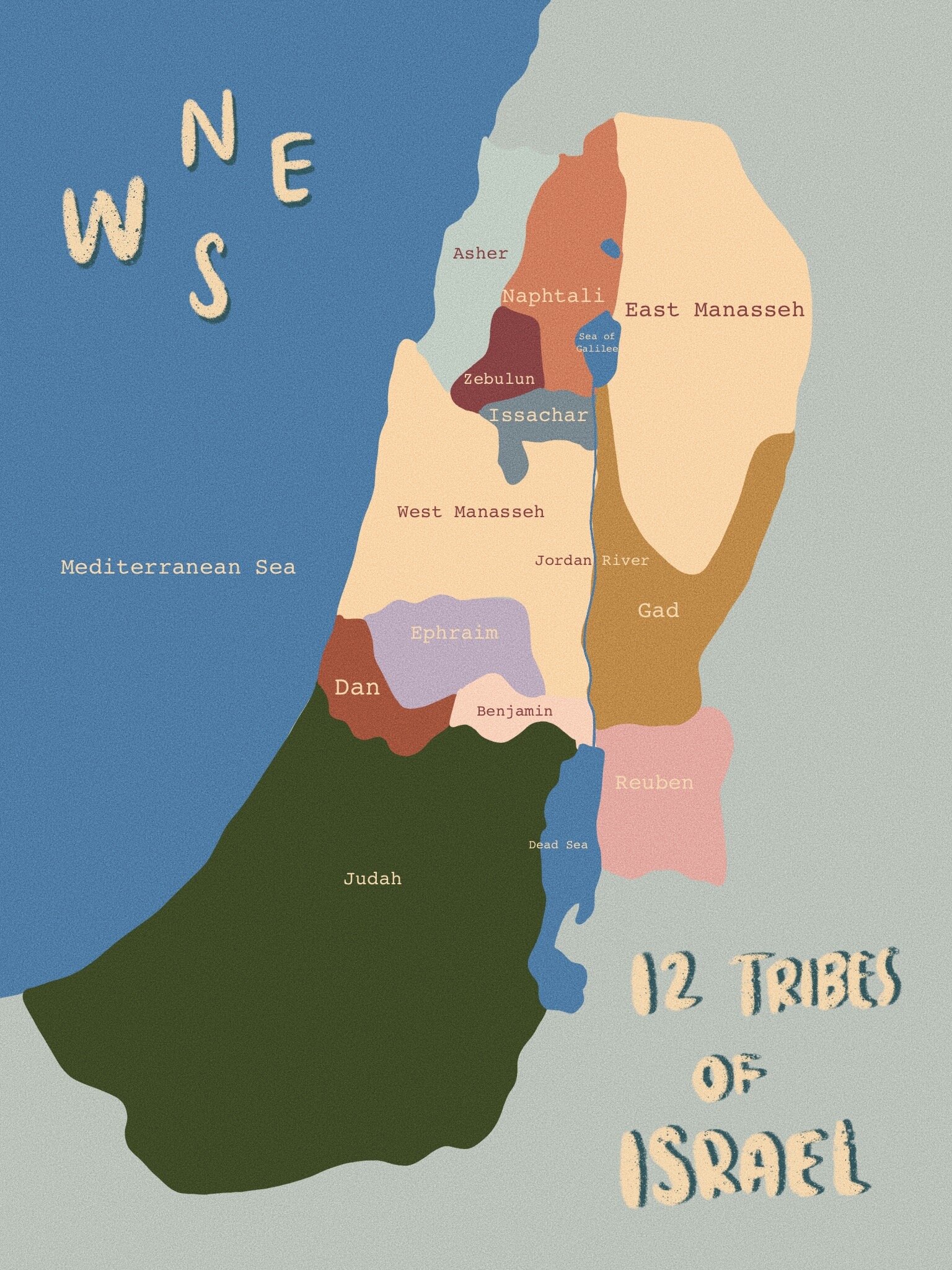
Once the kingdoms in the promised land had been defeated and devoted to destruction, it was time for Israel to inherit what God had given them. In chapters 12 and 13 we read of the allotment of the land to the tribes of Reuben, Gad, and half of Manasseh. These had been promised to them when Moses was alive but they vowed to help conquer the rest of the land before settling into their respective homes. Joshua is a book showing the inheritance and where each tribe ended up. Here is a visual to help you understand.
God was the suzerain party in the covenant made between Him and the Israelites. Being the King in this agreement, God gave the people their inheritance by tribes. 11 portions of land were given, Simeon was scattered among Judah, and the Levites were given the inheritance of the Lord’s offerings as the priests and caretakers of the temple. Why would God’s sovereignty be important to the story of the Israelite’s allotted land?

Chapters 15-17 give an extensive list of the borders of the tribe of Judah, Ephraim, and Manasseh. Why would these portions be written about more than the other tribes? Why would Caleb’s inheritance be specifically included? Why would the specifics of the inheritance be important to the Israelites at the time? Why would it be important to later generations? If this book was written during the Babylonian exile, there would be a whole different history that would be significant to the reader. The kingdom of Judah would have already been split from the other tribes for a long time and now were in exile after outlasting the others. How would this affect how these chapters would be read?
In chapter 14 the text begins to detail the inherited land and what tribes and people were allotted what. First to receive land in this portion of the story is Caleb, one of the spies that had gone in to look at the land forty years before when God had send the Israelites with Moses to take the promised land. Chapter 19 ends with Joshua receiving his portion. He was the other spy that had encouraged the people that God would help them take the land when He said He would. Why would there be this inclusion here as it talks about the allotted land?
After giving each tribe their portion of land, they quickly establish their cities of refuge as God had commanded. These cities were important to keep justice and peace in order. God had told the people in the wilderness that they were to set this up and Joshua was ensuring that they followed through with it.

Within this portion of the story in Joshua, as the Israelites receive their promised land, the word rest is repeated. The Lord gave Israel rest, something He had also been promising since they left Egypt. At the end of chapter 21 it says that “all the good promises that the Lord had made to the house of Israel… came to pass.” Why would rest be a part of this and how did it go along with their allotted inheritance?

As Reuben, Gad, and the half tribe of Manasseh returned home, they created an altar that caused problems with the rest of Israel. Thinking they had already turned away from God, the other tribes prepared to go to war against their brothers. This conflict was easily resolved when the tribes talked and they realized the Israelites East of the Jordan had made the altar as a sign of their commitment to the Lord. Why would a physical altar be needed as a symbol for the people? What would this mean to the Israelites in later generations that read of their ancestors settling in the land God had promised? How did this altar witness the hearts of the tribes that lived across the Jordan?
The connective word “therefore” is repeated throughout these last two chapters of Joshua.
What God Did
Fought for you
Drove out nations
Allotted your inheritance
Fulfilled His promise
Why would the list of how the Israelites should respond be longer than the list of what God did? Why would the book of Joshua end this way?
Therefore
What You Will Do
Be strong
Keep the Law
Do not mix with nations
Do not worship other gods
Cling to God
Love God
Fear God
Serve God in sincerity and faithfulness
The end of these sections also remind the people of the other side of God’s covenant with them. If they failed to obey His word, curses would come upon them. Why would this be significant to those listening to Joshua speak and those reading his words later on?
The beginning of chapter 24 lays out God’s faithfulness to Israel since He chose Abraham. It gives a simple overview of the history we read in depth through the first six books of the Bible. How God moved in one man’s life and remained faithful to His line as He showed who He was to the world through them and for them. Along the way, every promise He made He fulfilled. The End of chapter 24 shows that even Joseph’s desire to be buried in Shechem was answered. Go back through these books and look for each promise God made, know that He answered each of them and those that haven’t been answered yet will be. Be encouraged that the rest of this Book is filled with more fulfillments and promises as well.

You Finished Joshua!
Now that you have finished observing and interpreting, I would encourage you to reflect on the timeless truths you have found in the Word and to apply it to your life. Here are some questions to help bring Joshua home.